
Grade 4 English Worksheet on Homophones (hour/our)

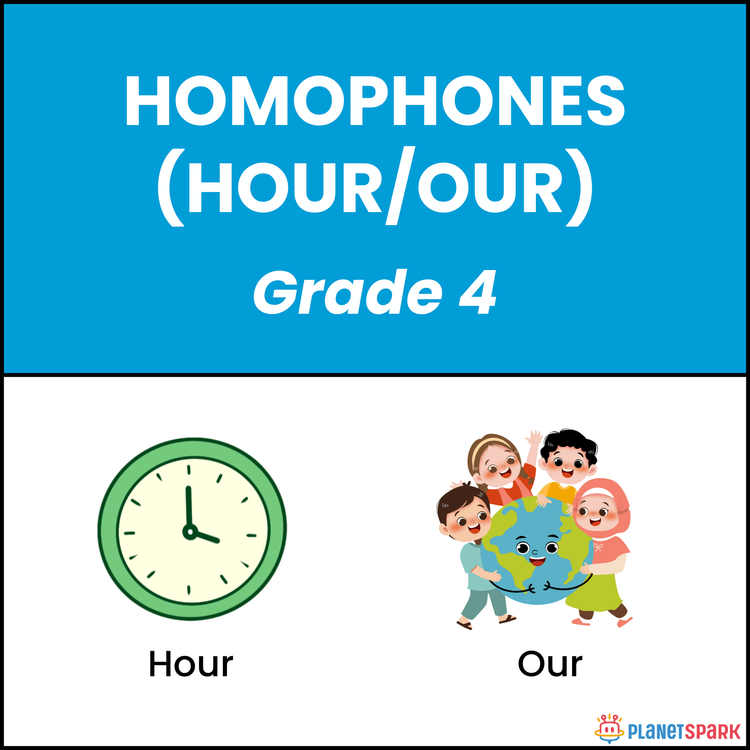
Grade 4 English Worksheet on Homophones (hour/our)
Homophones (Hour/Our) for Grade 4
This Grade 4 worksheet focuses on understanding the homophones "hour" and "our." It is designed to strengthen grammar skills through engaging and interactive exercises. The exercises are tailored to help students differentiate between these commonly confused words by using them in various contexts.
Why Homophones Matter in Grammar?
Homophones are words that sound the same but have different meanings and spellings:
1. Learning them helps students avoid confusion and improve their writing and speaking skills.
2. Mastering homophones enhances a child's writing clarity and accuracy.
3. Ensuring they use words correctly in both written and spoken communication.
4. It is designed to strengthen grammar skills through engaging and interactive exercises.
What's Inside This Worksheet?
This worksheet includes multiple activities designed to help students learn the difference between "hour" and "our":
Exercise 1: True and False
This activity asks students to read statements about "hour" and "our" and determine whether they are true or false.
Exercise 2: Sorting Words into 'Hour' or 'Our'
Students are tasked with sorting a list of words into two categories: those that refer to time (using "hour") and those that indicate possession or belonging (using "our").
Exercise 3: Fill-in-the-Blank Exercises
Students will fill in the blanks with the correct homophone, "hour" or "our," based on the context provided in each sentence.
Exercise 4: Multiple-Choice Questions
This section presents multiple-choice questions where students must choose between "hour" and "our" to complete sentences correctly.
Exercise 5: Sentence Writing Practice
Students are asked to write sentences using both "hour" and "our" in various contexts.
Answer Key (For Parents and Educators)
Exercise 1 – True and False
1. T
2. T
3. F (Hour tells about time, not ownership.)
4. T
5. T
6. F (Our is not used for time measurement.)
7. F (Our is not related to clocks.)
8. T
9. F (Hour means a unit of time, not belonging to a group.)
10. F (Our can show possession.)
Exercise 2 – Sort the Words
hour: hour/wait, hour/drive, hour/movie, hour/game, hour/nap, hour/walk, hour/delay
our: our/team, our/planet, our/school, our/teacher, our/family, our/clothes, our/city, our/country
Exercise 3 – Fill in the Blanks
1. hour
2. Our
3. hour
4. hour
5. our
6. Our
7. hour
8. Our
9. hour
10. our
Exercise 4 – Choose the Correct Homophone
1. d) hour
2. c) our
3. b) hour
4. c) hour
5. a) our
6. b) our
7. a) hour
8. d) Our
9. c) hour
10. d) our
Exercise 5 – Write Sentences Using "hour" and "our." (Answers may vary)
1. I spent an hour reading my book.
2. This is our classroom.
3. Our house is near the park.
4. We waited for an hour to see the doctor.
5. We are going to our friend's birthday party.
6. The train will arrive in an hour.
7. Our parents are going on vacation next week.
8. I worked for an hour on my homework.
9. This is our team’s victory.
10. The movie lasted for an hour.
Help your child master homophones today with a Free 1:1 Communication Skills Trial Class at PlanetSpark.
Frequently Asked Questions
Homophones are words that sound the same but have different meanings or spellings, like 'hour' and 'our'.
By teaching them through sentences where the context shows which homophone is correct.
Misusing homophones can lead to errors in writing, so understanding their meanings is key for accuracy.